

.png)
%402x.svg)
In the public sector, procurement is often described as a "puzzle" where the pieces—policy, compliance, budget, and logistics—rarely seem to fit together seamlessly. While the private sector has spent the last decade perfecting "just-in-time" supply chains and automated purchasing, many government agencies remain tethered to paper-heavy processes, fragmented vendor data, and manual reconciliation.
The consequences of an inefficient government supply chain go far beyond administrative headaches. Delays in procurement can mean critical infrastructure projects stalled, healthcare facilities under-equipped, or emergency services lacking the tools they need to respond to a crisis.
However, a shift is occurring. Forward-thinking government leaders are realizing that they don't have to solve this puzzle alone. By leveraging Business Process Outsourcing (BPO), agencies are finding they can offload the "noise" of procurement administration to specialized partners, allowing them to focus on strategic sourcing and high-level policy.
At We Win, we see procurement BPO not just as a way to "outsourced tasks," but as a vehicle for Digital Maturity. Here is how BPO is helping governments solve the procurement puzzle.
The Weight of the Legacy: Why Government Procurement Stalls
Government procurement is inherently more complex than private sector purchasing. It is governed by strict transparency laws, social equity mandates (such as supporting small or minority-owned businesses), and rigorous auditing requirements.
These necessary safeguards often create a "friction tax" that slows down the supply chain:
- Manual Data Entry: Thousands of invoices and purchase orders (POs) manually keyed into legacy systems.
- Vendor Management Gaps: Outdated vendor databases that make it difficult to verify compliance or negotiate volume discounts.
- Lack of Spend Visibility: Not knowing exactly where the money is going in real-time, making budget forecasting a guessing game.
This is where the BPO model provides a breakthrough. By integrating specialized teams and modern technology, BPO partners bridge the gap between "how things are done" and "how they should be."
1. Digitizing the "Paper Trail": From Invoices to Intelligence
The first step in streamlining the supply chain is eliminating manual, paper-based workflows. A BPO partner acts as the Digital Engine for the accounts payable and receivable process.
The BPO Advantage:
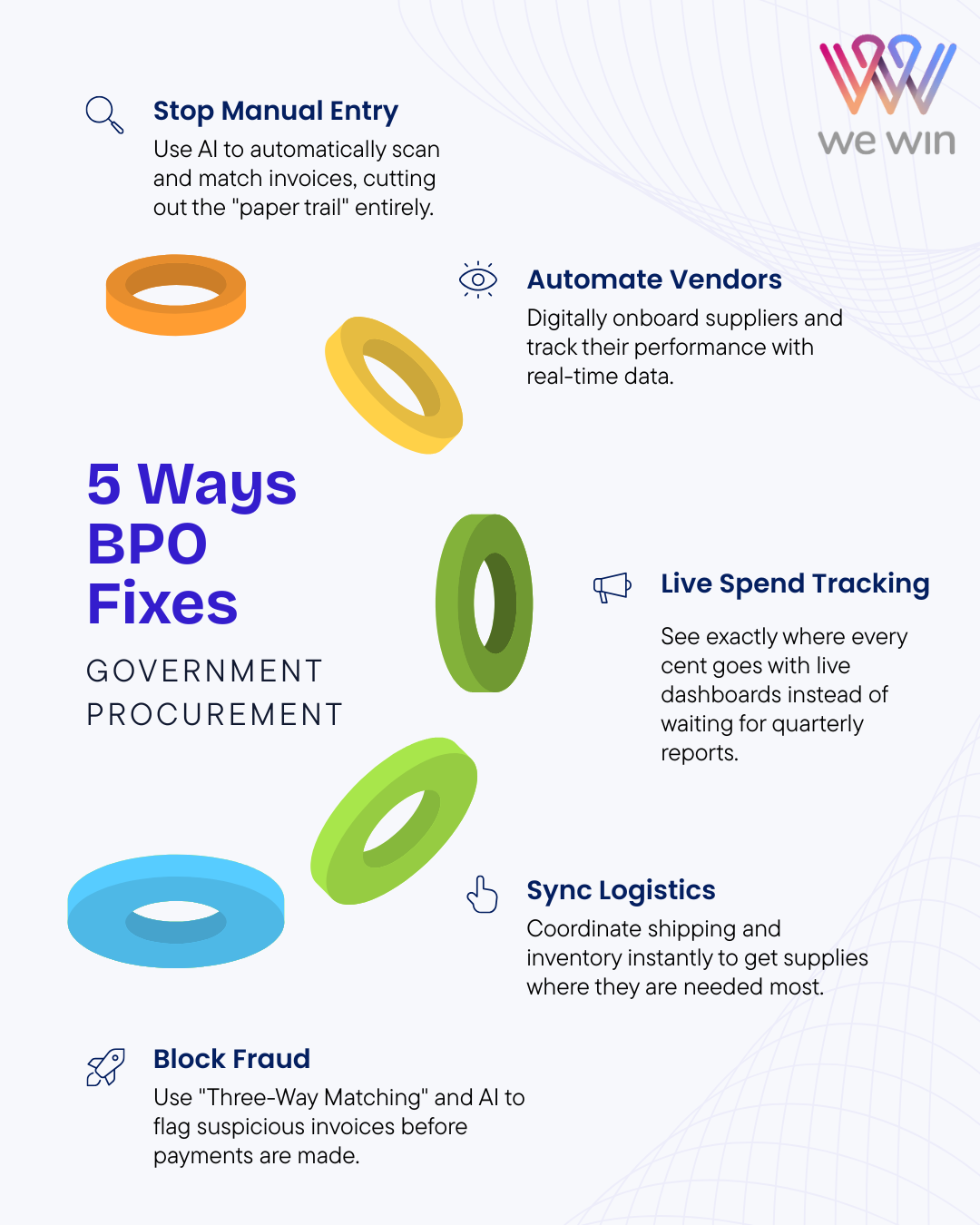
- Intelligent Document Processing (IDP): Instead of staff typing in data, BPO partners use AI-powered OCR (Optical Character Recognition) to scan invoices, extract relevant data, and automatically match them with purchase orders.
- Exception Handling: In a traditional setup, a mismatched invoice can sit on a desk for weeks. A BPO team identifies these exceptions immediately, resolves the discrepancy with the vendor, and keeps the workflow moving.
- Cloud-Native Records: Transitioning to digital-only records ensures that every step of the procurement process is timestamped and auditable, which is critical for government transparency.
2. Strategic Vendor Relationship Management (SRM)
A government’s supply chain is only as strong as its vendors. Managing thousands of suppliers—from local construction firms to global technology providers—is a massive undertaking.
The BPO Advantage:
- Automated Onboarding: BPO partners streamline the vendor registration process, ensuring all tax documents, certifications, and compliance checks are completed digitally before a contract is even signed.
- Performance Monitoring: Are your vendors delivering on time? Are they meeting quality standards? BPO providers use data analytics to track vendor performance, giving government agencies the leverage they need during contract renewals.
- Compliance Guardrails: A specialized BPO partner ensures that every purchase adheres to the specific regulatory requirements of the agency, reducing the risk of audit failures or legal challenges.
3. Real-Time Spend Analytics and Budget Optimization
One of the greatest "puzzle pieces" in government is the lack of real-time data. Often, agencies don't see their total spend until the end of a quarter or fiscal year.
The BPO Advantage:
- Consolidated Dashboards: By digitizing all procurement data, a BPO partner like We Win can provide real-time dashboards. Leadership can see exactly what is being spent, by which department, and on what categories.
- Identifying Savings: Data analytics can reveal "maverick spending" (buying outside of negotiated contracts) or opportunities for bulk-buying across different agencies, leading to significant taxpayer savings.
- Predictive Forecasting: Machine learning can analyze historical spend patterns to help agencies predict future supply chain needs, preventing "panic buying" or stockouts of essential supplies.
4. Solving the "Last Mile" of Logistics
In many cases, procurement doesn't end when the order is placed; it ends when the goods are delivered and verified. Coordinating the logistics of a government supply chain—especially across a large state or municipality—is a logistical nightmare.
The BPO Advantage:
- Logistics Coordination: BPO teams manage the communication between vendors, shipping companies, and receiving departments. They track shipments in real-time and provide updates to the stakeholders who are waiting for the supplies.
- Inventory Management: Specialized BPO services can integrate with warehouse systems to ensure that stock levels are optimized—never too high (wasting budget) and never too low (stalling operations).
5. Enhancing Transparency and Reducing Fraud
Public trust depends on the integrity of the procurement process. Manual, fragmented systems are prone to errors and, unfortunately, can be vulnerable to fraud or "ghost" invoicing.
The BPO Advantage:
- Three-Way Matching: BPO systems automatically verify that the Purchase Order, the Receiving Report, and the Vendor Invoice all match perfectly before a payment is released.
- Audit Readiness: Because every transaction is digitized and logged, internal and external audits become much faster and less intrusive. The data is always "ready."
- Fraud Detection AI: Modern BPO platforms use algorithms to spot unusual patterns, such as duplicate invoices, suspicious bank account changes, or price spikes, flagging them for human review before any money leaves the agency.
Fitting the Pieces Together
The "Procurement Puzzle" isn't solved by working harder; it’s solved by working smarter. By partnering with a specialized BPO provider, government agencies can transform a slow, manual supply chain into a lean, digital operation.
At We Win, we understand that procurement is the lifeblood of government service. Our goal is to handle the complexity of the process so that you can focus on the mission. We don't just provide "support"; we provide a Modernized Supply Chain that is built for the demands of the 21st century.
Is your procurement process holding your agency back? It’s time to move beyond the paper and into the future. [Contact We Win Today] to see how our BPO solutions can digitize and streamline your supply chain operations.


