

.png)
%402x.svg)
For decades, the relationship between government agencies and Business Process Outsourcing (BPO) providers was simple, clinical, and strictly transactional. The agency had a volume of work—calls to answer, forms to process, or data to enter—and the BPO provided the "arms and legs" to do it at the lowest possible cost.
In this "Vendor" model, success was measured by simple math: Did they answer the phone within 30 seconds? Did they process X number of applications today?
However, the world has become too complex for simple math. Citizens now expect Amazon-level service from their local government. Cybersecurity threats have moved from the fringe to the forefront. Budgets are under microscopic scrutiny. In this high-stakes environment, a BPO that simply "follows instructions" is no longer an asset; they are a bottleneck.
The most successful public sector organizations are moving away from Transactional Vendors and toward Transformational Strategists.
At We Win, we believe this shift is the difference between surviving a crisis and leading through one. But how do you know which one you have? Here is how to distinguish between a vendor and a strategist.
1. The Metric Mindset: Activity vs. Outcomes
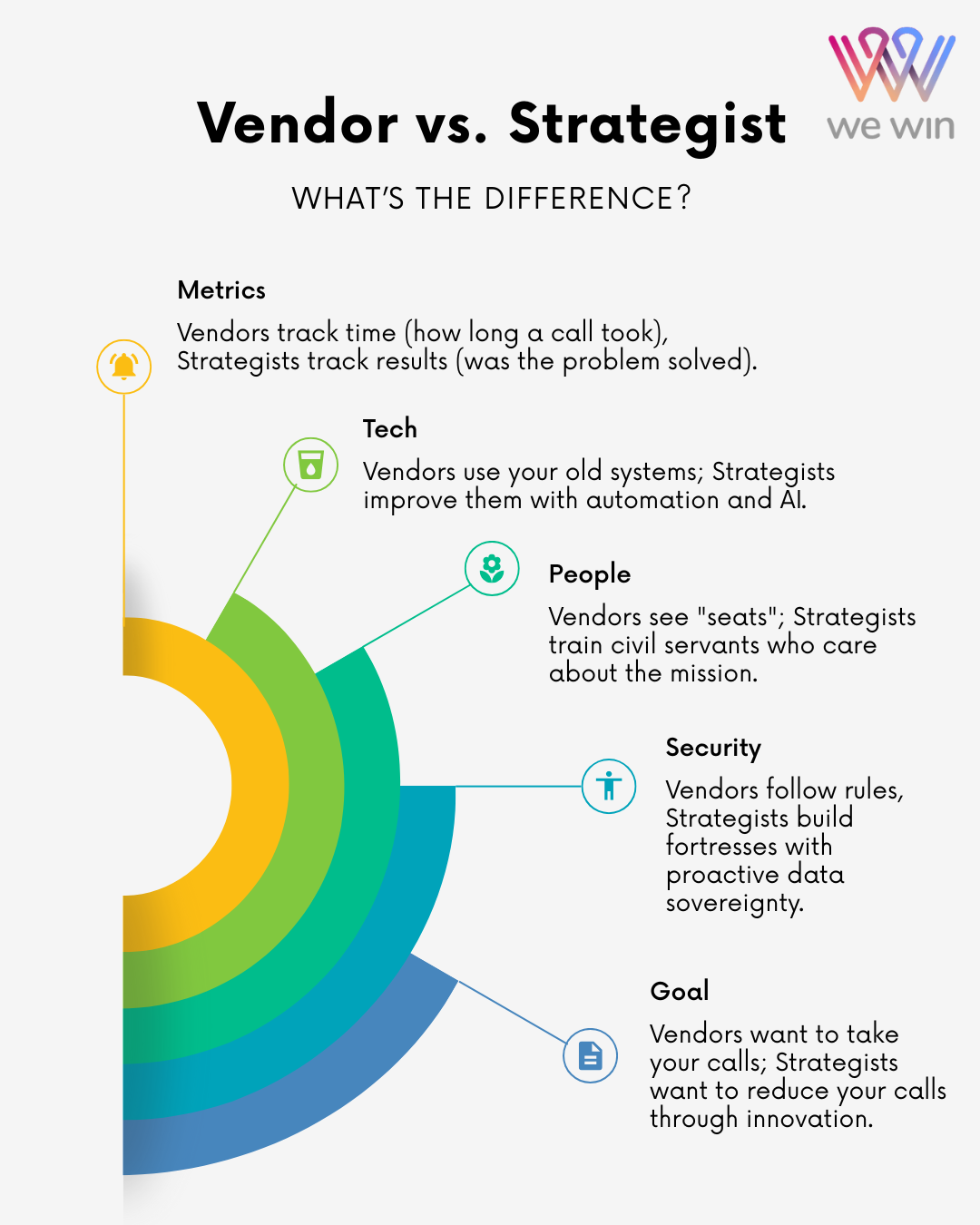
The clearest indicator of a transactional vendor is their obsession with "Input Metrics." They talk about Average Handling Time (AHT), occupancy rates, and headcount. Their goal is to prove they were busy.
A Transformational Strategist focuses on "Outcome Metrics." They want to talk about First Contact Resolution (FCR), Citizen Satisfaction (CSAT), and Failure Demand Reduction.
The Difference in Action:
- The Vendor: "We took 50,000 calls this month and met our wait-time targets."
- The Strategist: "We noticed 20% of your calls were citizens asking for simple status updates. We deployed a self-service SMS tool to handle those, reducing your call volume by 10,000 and freeing up our expert agents for complex casework."
A strategist doesn't just want to manage your volume; they want to help you understand—and eventually reduce—it.
2. Technology: "Using Systems" vs. "Improving Systems"
A transactional vendor is a "user." They log into your legacy systems, follow the manual, and alert you when something breaks. They are passive participants in your technology stack.
A Transformational Strategist is an "enabler." They look at your legacy systems and find ways to build digital bridges.
The We Win Approach: We don't just "sit" on your systems. We look for opportunities for Intelligent Automation. If a process requires an agent to copy data from three different screens, a strategist proposes a Robotic Process Automation (RPA) solution to do it in milliseconds. They bring GovTech maturity to the table, helping you modernize without the risk of a full "rip and replace" project.
3. The Human Element: Commodity vs. Civil Servant
To a vendor, agents are a commodity. They are "seats" to be filled. Training is often "just-in-time" and focused on the bare minimum required to avoid a penalty. This leads to high attrition and robotic, script-driven interactions.
A Transformational Strategist views agents as a specialized extension of the civil service.
The Difference in Action: Strategists invest in Talent Governance. At We Win, our agents are trained on the "Why" behind the "What." They understand the mission of the agency and the legislative context of the work. This creates an "Ownership Culture" where agents are empowered to solve problems rather than just transfer callers.
4. Risk Management: Compliance Checklist vs. Proactive Sovereignty
For a vendor, security is a hurdle to clear during the RFP process. They sign the NDA, install the antivirus, and consider the box checked. They are reactive—waiting for an audit or a breach to take action.
A Transformational Strategist treats security and data sovereignty as the foundation of the partnership.
The Difference in Action: A strategist brings a Security-First Architecture. They don't just follow your security policy; they suggest improvements based on the latest global threats. They provide "Clean Desk" virtual environments, biometric authentication, and geo-fencing as standard, knowing that in the public sector, a single data leak can destroy years of public trust.
5. Governance: "Checking In" vs. "Co-Designing"
Transactional relationships are managed through monthly "Performance Reviews" that often feel like a battle over service level credits. It is a "You vs. Them" dynamic.
Transformational partnerships are managed through Co-Governance.
The Difference in Action: In a strategic partnership, the BPO has a seat at the planning table. When the agency is considering a new policy or a digital rollout, the strategist provides data-driven insights on how that change will affect the citizen experience. They share the risk and the reward. If a strategist finds a way to save the agency money through innovation, the partnership is structured to incentivize that behavior.
Which Partner Are You Signed With?
The transition from a vendor to a strategist doesn't happen by accident. It requires a shift in procurement, a change in KPIs, and a willingness to trust a partner with your mission, not just your tasks.
A Vendor will save you a few cents today.
A Strategist will save your reputation, your budget, and your future.
At We Win, we made the choice long ago to never be "just a vendor." We are in the business of public sector transformation. We measure our success by the trust we build and the public value we unlock.
Is it time for a more strategic conversation? If your BPO partner isn't bringing you ideas, they are just taking your money. [Contact We Win Today] to discover what a transformational partnership looks like.


