

.png)
%402x.svg)
The public sector workforce shortages represent an existential crisis for modern governance. Across every federal, state, and local agency, leaders are grappling with a toxic combination of a mass retirement wave, an inability to compete with private sector wages for technical talent, and crushing administrative workloads that drive remaining staff into burnout and high turnover.
The result? Citizen services slow down, digital transformation in government projects stall, and the very trust citizens place in their government erodes.
Traditional recruitment and retention methods—slow hiring cycles, competitive salaries that never quite catch up, and mandated training programs—are clearly failing to solve this problem at the necessary scale.
The answer lies in a fundamental operational shift: leveraging Strategic BPO (Business Process Outsourcing) not as a cost-cutting measure, but as the only viable solution for immediate workforce resilience and sustainable access to specialized skills. This article explores the anatomy of the public sector talent crisis and demonstrates how BPO provides the elastic workforce model necessary to restore efficiency, secure talent, and preserve public sector customer service.
The Anatomy of the Public Sector Talent Drain
The talent crisis facing government is unique. It’s not just a shortage; it's a systemic failure to staff functions critical to national and local operations.
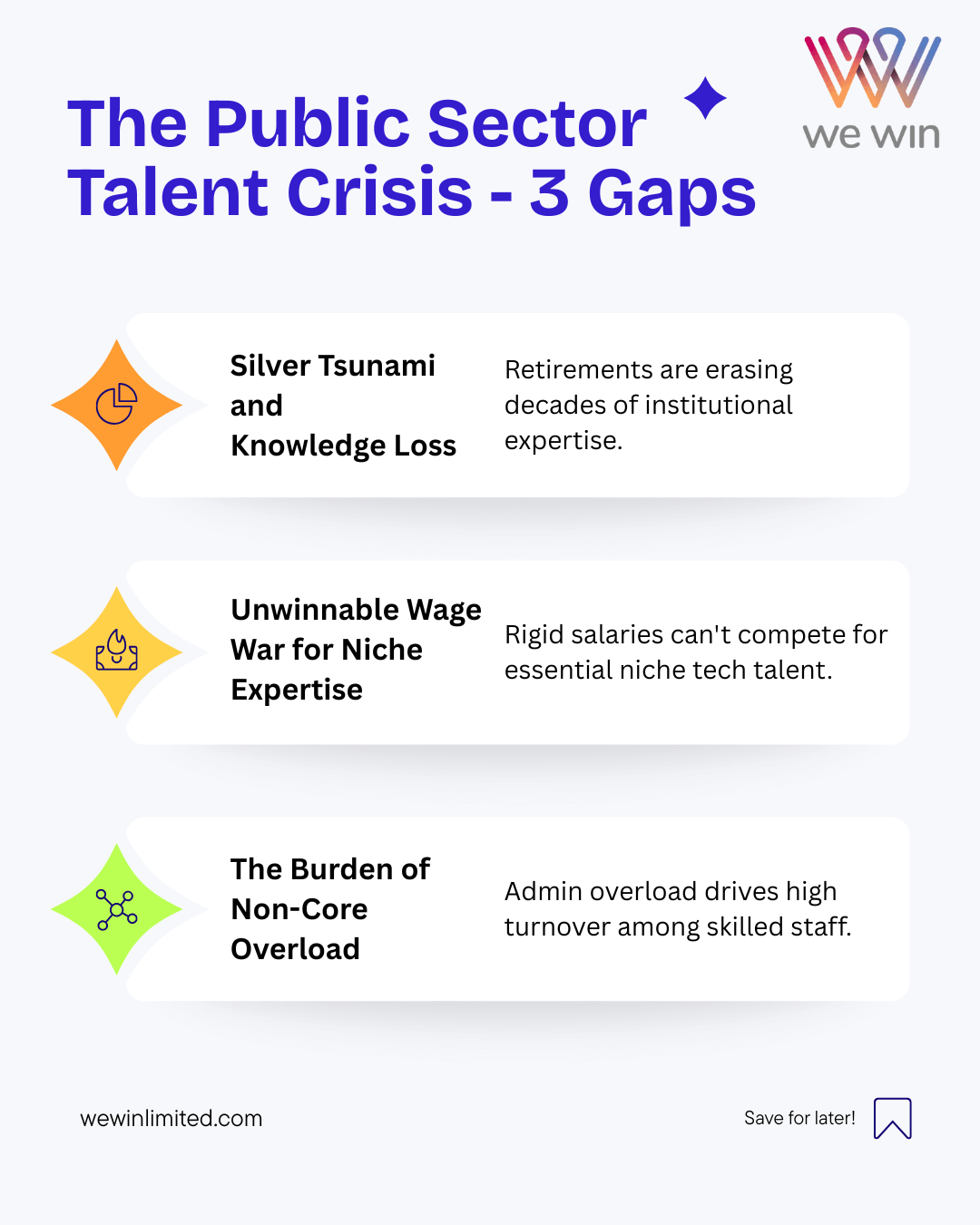
1. The Silver Tsunami and Knowledge Loss
A massive wave of retirement among long-tenured civil servants is underway, often referred to as the "Silver Tsunami." These departures are not just a matter of lost headcount; they represent the loss of decades of institutional knowledge, policy history, and procedural expertise that is rarely documented or easily transferable. When key personnel leave, entire processes can become bottlenecked or halt altogether.
2. The Unwinnable Wage War for Niche Expertise
The need for highly specialized skills—cybersecurity analysts, cloud architects, AI governance experts, and data scientists—has exploded due to rapid digital transformation in government. However, public sector salary structures are rigid and often cannot compete with the dynamic compensation packages offered by the private sector. Agencies struggle to recruit a handful of these experts, let alone build entire departments dedicated to continuous monitoring or advanced analytics. This creates inevitable niche expertise gaps.
3. The Burden of Non-Core Overload
Current public sector staff are often overwhelmed by administrative, non-core tasks (Tier 1 helpdesk calls, routine data entry, managing legacy system maintenance). This heavy administrative load diverts their time away from high-value, complex, or strategic work—the kind of work that provides intellectual fulfillment and prevents staff burnout. Highly skilled employees become demoralized when they spend 50% of their time on mundane, repeatable tasks, accelerating the talent drain.
Why the Internal "Build-It-All" Model Fails Now
Faced with these shortages, the default reaction is often to "build it all in-house"—launching massive recruitment drives, developing extensive training programs, and investing in new office space. For the modern public sector, this approach is fatally flawed.
The Impossibility of Elastic Scaling
Government demand is inherently volatile. Massive spikes occur during tax season, open enrollment periods, public health crises, or following regulatory changes. The internal model is fixed: staff size is budgeted for the average workload. Attempting to scale up requires launching slow, multi-month hiring cycles for temporary staff, which is prohibitively costly, administratively burdensome, and prone to error. When the crisis passes, these temporary hires must be released, creating public relations and morale issues. Internal models simply cannot match the instant capacity adjustment needed to maintain effective 24x7 Citizen Support.
The High Cost of Lagging Technology
To attract technical talent, government must offer state-of-the-art tools. However, government technology procurement is notoriously slow and expensive. Agencies struggle to invest in and train staff on the latest platforms (e.g., sophisticated CRM systems, advanced AI triage tools). This technological lag acts as both a deterrent to new hires and a source of frustration for existing employees, further accelerating turnover.
The Time-to-Competency Trap
Even if an agency manages to hire a new employee, it takes months—often a year or more—to navigate the onboarding, security clearance, and in-depth regulatory training required for public sector roles. By the time the new hire is fully productive, the problem they were hired to solve may have already evolved, or a key colleague may have retired. The time-to-competency is too slow to effectively combat the rapid talent drain.
Strategic BPO - The Workforce Resilience Strategy
Strategic BPO offers the essential countermeasure to the public sector's workforce crisis. By focusing on Government Outsourcing as a Workforce Resilience strategy—rather than merely a cost-cutting exercise—agencies gain an elastic, ready-made talent pool that instantly solves the three core problems detailed above.
1. Elastic Capacity: Solving Burnout and Surge Demand
BPO provides an elastic workforce that can be scaled up or down on demand. This converts the public sector's largest operational risk—unpredictable surge volume—into a predictable, variable operational expense (OpEx).
- Crisis Management: When a natural disaster or major legislative change hits, the BPO partner instantly activates pre-trained personnel to manage the surge in calls and applications, protecting the internal team from catastrophic overload and burnout.
- Focus on Core: By offloading high-volume, repeatable tasks (e.g., managing Tier 1 calls, infrastructure monitoring) to the BPO partner, the internal team is freed to focus 100% on core competencies—policy interpretation, complex case resolution, and strategic oversight. This shift in focus drastically improves internal staff morale and retention.
2. Immediate Access to Niche Expertise
The BPO model immediately closes the niche expertise gaps that recruitment alone cannot fill.
- Ready-Made Skills: BPO providers are built to retain and deploy highly specific, certified talent (e.g., multilingual support, cloud security specialists, legacy system maintainers) who serve multiple clients. An agency gains instant access to this talent without the years of recruiting and training investment.
- Technological Advancement: The BPO partner absorbs the high CapEx cost of purchasing and maintaining advanced technology (AI, RPA, next-gen CRM). This means government agencies can deploy cutting-edge AI-driven citizen services overnight, making their support function faster and more efficient, without draining internal IT budgets or hiring specialized automation engineers.
3. Mitigating Operational Risk and Ensuring Trust
In the public sector, risk mitigation is paramount. Government Outsourcing to a reputable partner can actually reduce operational, compliance, and security risks compared to managing the function with a strained, under-resourced internal team.
- Compliance as a Service: High-quality BPO firms operate under rigorous international compliance standards (ISO, GDPR, HIPAA). Delegating regulated processes to them ensures specialized expertise is applied to data handling and process management, significantly reducing the agency's risk of regulatory penalties.
- 24/7 Cybersecurity Shield: An internal government IT team cannot realistically afford a 24x7 Security Operations Center (SOC). A BPO partner assumes the continuous responsibility for monitoring, patching, and incident response within the scope of work, providing a level of defense and redundancy that bolsters Workforce Resilience.
Making the Strategic Shift: Implementation Best Practices
For public sector leaders ready to address the talent drain strategically, the implementation phase requires clarity and rigor.
Step 1: Define Core vs. Non-Core Work
The first step is a comprehensive audit to identify tasks that must remain internal (policy interpretation, final decision-making, core strategy) versus high-volume, repeatable tasks that can be standardized and managed by an external partner. This clarity ensures that Strategic BPO amplifies, rather than diminishes, internal capabilities.
Step 2: Focus on Resilience Metrics, Not Just Cost
The procurement criteria for the BPO partner must prioritize:
- Scalability: Proven ability to handle 50% or 100% surge capacity on short notice.
- Expertise: Certifications and demonstrated ability in the required niche expertise (e.g., specific legacy system knowledge).
- Compliance and Security: Non-negotiable adherence to the highest data privacy standards required for citizen services.
Step 3: Establish a Unified Governance Model
Successful Government Outsourcing requires a tightly managed partnership. Agencies must establish clear Service Level Agreements (SLAs), detailed communication protocols, and a continuous feedback loop to monitor performance, ensure data quality, and maintain a seamless citizen experience across both internal and outsourced functions.
Conclusion
The "Great Talent Drain" is not a temporary inconvenience; it is a structural challenge that demands a structural solution. Continuing to rely on slow, fixed internal models will only exacerbate public sector workforce shortages, leading to deeper burnout, operational failures, and a decline in public sector customer service.
Strategic BPO provides the essential elasticity to manage volatile demand, the immediate access to the niche expertise that recruitment cannot secure, and the operational freedom to redirect remaining internal staff to high-value, satisfying, core strategic work.
By embracing BPO as a Workforce Resilience strategy, government leaders can future-proof their operations, ensure 24x7 Citizen Support, and finally deliver the agile, modern citizen services the public deserves. The time to transition from reacting to the talent drain to proactively building an elastic workforce model is now.
Are you ready to convert your biggest workforce challenge into your greatest operational strength?


