

.png)
%402x.svg)
.png)
Let’s be honest: when you hear "outsourcing" in the public sector context, your mind likely jumps to call centers handling tax queries or data entry clerks digitizing forms. While these Business Process Outsourcing (BPO) functions are the vital heartbeat of daily operations, they are just the beginning of the story.
The real battleground for modern governance isn't just about processing forms faster; it’s about understanding what those forms mean. Government agencies today are drowning in data—from citizen grievances to census demographics—but they are starving for insight.
This is the dawn of Knowledge Process Outsourcing (KPO) in Public Policy Analysis. It represents a strategic shift from outsourcing tasks to outsourcing intelligence, and for the C-suite executive navigating complex public needs, it is the key to unlocking a smarter, more responsive future.
The Data Paradox - Why Governments Have Information but Lack Insight
Public policy was once driven largely by intuition and historical precedent. Today, it is driven by data. Every citizen interaction, every service request, and every grievance filed creates a data point. However, having data and having intelligence are two very different things.
The Challenge of Unprocessed Citizen Data
Internal teams are often overwhelmed by the sheer volume of raw information. They spend 90% of their time collecting and cleaning data, leaving almost no time to analyze it. This leads to reactive governance—fixing problems only after they have escalated—rather than proactive, data-driven policy making.
When decisions are delayed because the "why" hasn't been extracted from the "what," the cost isn't just financial; it’s social. It erodes public trust. The "do-it-all-in-house" model is struggling to keep up with the demand for rapid, accurate analysis.
The Internal Gridlock - Why In-House Teams Struggle to Scale Analysis
For the COO or Department Head reviewing the efficiency of their unit, building a dedicated internal research and analysis wing is often a logistical nightmare. It represeznts a rigid fixed cost structure that cannot adapt to the fluidity of legislative sessions or sudden public crises.
The Burden of Administrative Overload
Your core internal teams should be focused on high-level strategy and decision-making. Instead, they are often bogged down in the weeds of administrative overload—collating reports, verifying beneficiary lists, or cross-referencing guidelines.
- Resource Drain: Highly paid civil servants spend hours on formatting reports rather than interpreting them.
- Scalability Issues: When a new scheme is launched, you cannot instantly hire 50 researchers to monitor its impact.
CapEx vs. OpEx - The Flexibility of Outsourced Teams
Maintaining large analysis teams in-house requires significant overhead (Capital Expenditure or CapEx). By shifting to a KPO model, organizations convert this into a flexible Operational Expense (OpEx). You can scale your analysis capabilities up or down based on project needs, ensuring you aren't paying for idle capacity during quiet periods.
Enter the KPO Model: Moving From "Doers" to "Thinkers"
So, what is the difference? Traditional BPO focuses on executing standardized rules (e.g., "Input Name Here").
Knowledge Process Outsourcing (KPO) in Public Policy Analysis focuses on judgment, interpretation, and domain understanding. It involves outsourcing core information-related business activities where the provider adds value through research and synthesis.
At We Win, we are evolving beyond traditional task execution. We view KPO as a strategic partnership where we help you understand the "Voice of the Citizen."
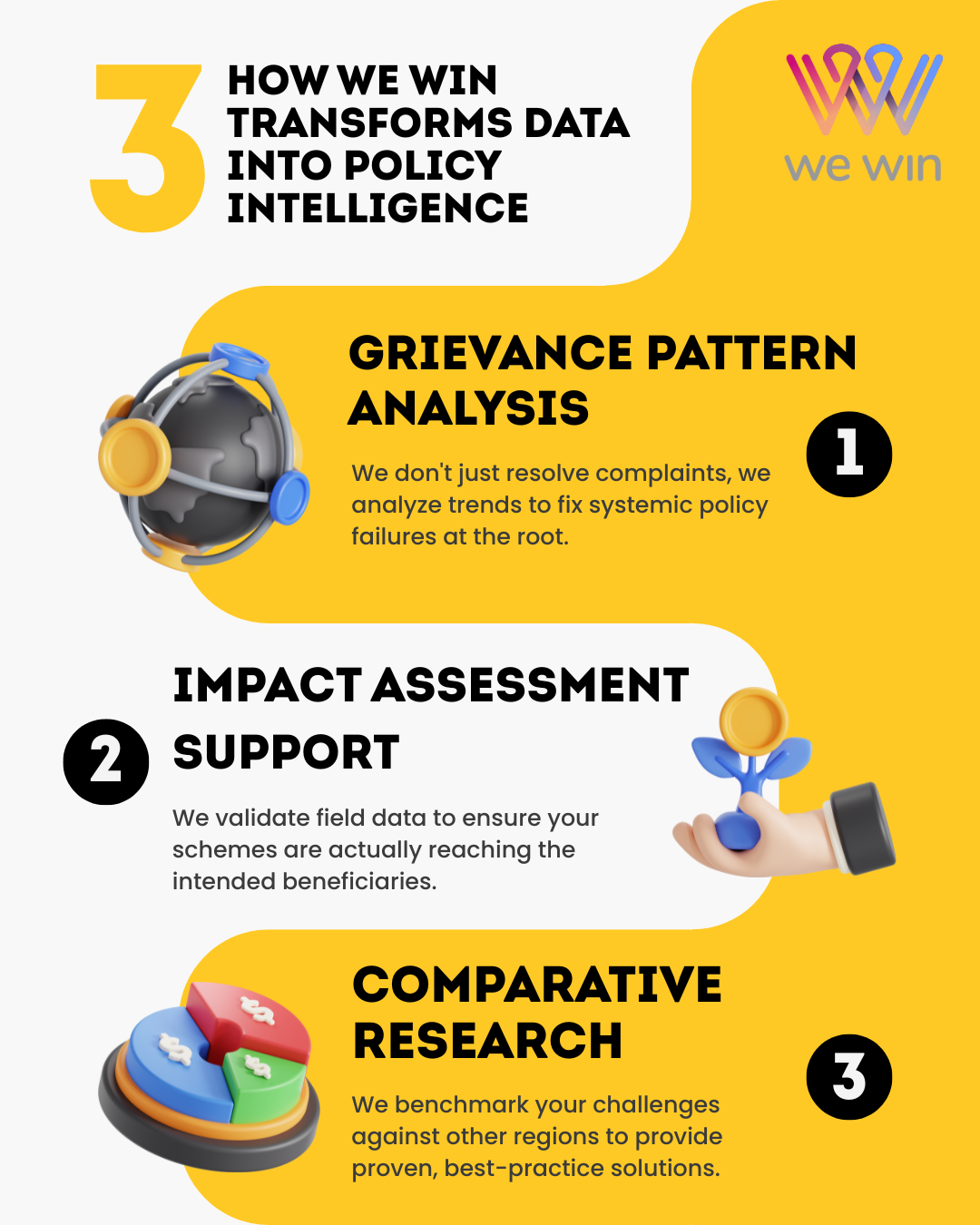
We Win’s Approach to Policy Support:
- Grievance Pattern Analysis: Instead of just resolving complaints, we analyze thousands of interactions to identify systemic policy failures.
- Impact Assessment Support: We assist in gathering and validating field data to see if a new policy is actually reaching its intended beneficiaries.
- Comparative Research: Our teams conduct deep-dive research into how other states or regions handle similar challenges, providing you with best-practice benchmarks.
Strategic Value & ROI - How We Win Accelerates Policy Success
Why should a C-suite leader trust an external partner with policy analysis support? Because in a complex world, dedicated focus yields better results.
1. Transforming Grievance Data into Policy Intelligence
We don't just log calls; we listen to them. Our KPO teams review vast amounts of citizen feedback to categorize sentiment and identify trending issues. If 40% of calls in a specific district relate to water shortages, we flag this data trend immediately. This allows you to pivot policy based on real-world evidence, not just assumptions.
2. Operational Efficiency and Speed-to-Implementation
In the public sector, time is the enemy of reform. By leveraging We Win’s established infrastructure, you bypass the lag of hiring and training internal researchers. We provide:
- Rapid Deployment: Teams ready to tackle data synthesis for new schemes immediately.
- Standardized Reporting: We turn chaotic data streams into clear, executive-level dashboards and briefs.
- Scalability: Need to audit a scheme across 10 districts in one month? We scale our teams to meet the demand, ensuring operational efficiency.
3. Risk Mitigation through Thorough Validation
Policy errors often stem from bad data. A beneficiary list with duplicates or ineligible entries can lead to financial leakage and scandal.
- Human-in-the-Loop Validation: We apply rigorous manual and process-driven checks to data sets, ensuring that the information you base your decisions on is accurate.
- Regulatory Adherence: Our teams work within your specific compliance frameworks to ensure all analysis respects privacy and procedural norms.
By outsourcing the heavy lifting of verification and research, you mitigate risk by ensuring your foundational data is rock solid.
Preparing for the Future
The era of the generalist trying to do everything is fading. To navigate the complexities of the future, public sector organizations and the enterprises that serve them must embrace specialization.
Knowledge Process Outsourcing (KPO) in Public Policy Analysis is not about giving up control; it is about gaining clarity. By partnering with We Win, you free your core leadership team to focus on what they do best: making the final, hard decisions that shape society, secure in the knowledge that the research and data behind those decisions is accurate and comprehensive.
Don't let your policy strategy be defined by your internal bandwidth limitations. Move from reactive management to proactive, insight-led governance.
Ready to explore new opportunities in policy analysis?
Contact We Win Today to discuss how we can support your strategic goals with our evolving KPO capabilities. Let’s build a smarter future, together.


