

.png)
%402x.svg)
In the public sector, the Request for Proposal (RFP) is the bible of procurement. It is a document designed to define scope, standardize pricing, and, theoretically, eliminate risk. Government agencies spend months drafting them, and vendors spend weeks responding to them.
But after 28 years in the Government BPO industry, we have learned a fundamental truth: The RFP is just a map; it is not the territory.
An RFP can mandate "99.9% uptime," but it cannot predict a 400% surge in call volume during a natural disaster. An RFP can require "data security compliance," but it cannot enforce the culture of vigilance needed to prevent a social engineering attack. In short, while the RFP protects the contract, it does not necessarily protect the mission.
True risk mitigation in government outsourcing happens in the grey areas—the unwritten realities of public service delivery that only reveal themselves after the ink is dry.
As a veteran partner to public sector agencies, We Win has navigated nearly three decades of policy shifts, technological disruptions, and crises. Here is what that experience has taught us about moving beyond the "paper shield" of the RFP to build a truly resilient, risk-proof partnership.
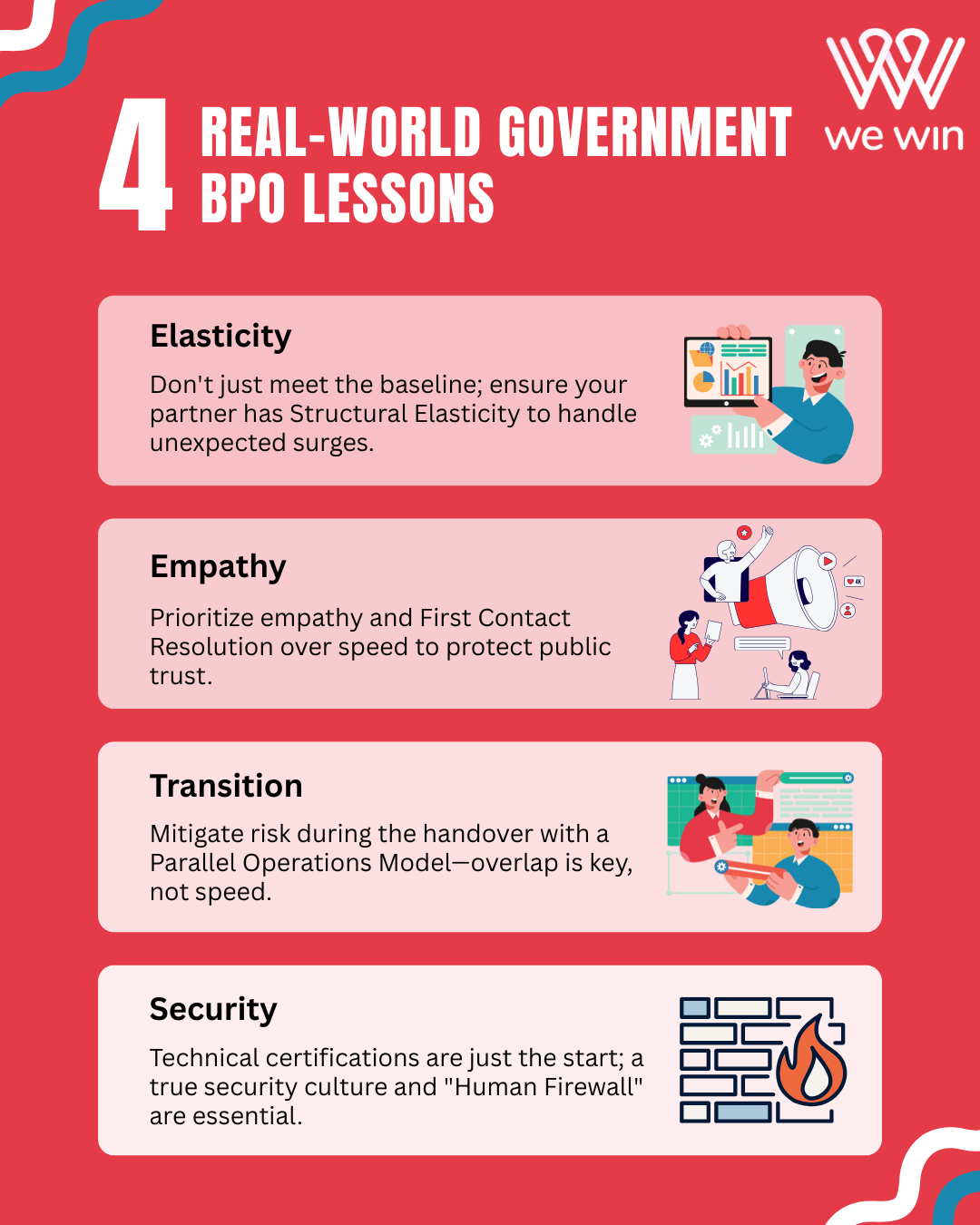
1. The "Elasticity" Lesson - Compliance is Static, Reality is Volatile
The RFP Requirement: “Vendor must provide 500 seats for Tier 1 support.” The Reality: A pandemic hits, or a new policy is passed overnight, and demand triples.
Most RFPs are built on historical data averages. However, government service demand is rarely average—it is episodic and volatile. The biggest operational risk agencies face is rigidity. If your BPO partner is staffed exactly to the letter of the RFP, they are already poised for failure when the unexpected happens.
The Risk Mitigation Strategy: We have learned that risk mitigation requires Structural Elasticity.
- Buffer Capacity: A mature BPO partner doesn't just hire for the target; they maintain a "bench" of cross-trained agents ready to deploy instantly.
- Shared Resource Models: Instead of dedicated silos, we utilize models where agents are trained on multiple similar government processes. This allows us to shift resources from a low-volume department to a high-volume crisis center in hours, not weeks.
- The Lesson: Don't just look for a vendor who can meet your baseline. Look for a partner who has a documented, tested Business Continuity Plan (BCP) for surge events.
2. The "Empathy" Lesson - Reputational Risk is the Silent Killer
The RFP Requirement: “Average Handling Time (AHT) must be under 4 minutes.” The Reality: A confused senior citizen is rushed off the phone, creating a viral social media story about government incompetence.
In the private sector, a bad customer service interaction costs a sale. In the public sector, it costs public trust. Reputational risk is arguably the most dangerous threat to a government agency. When citizens feel unheard or mistreated, the backlash can derail legislative agendas and end careers.
The Risk Mitigation Strategy: Experience has taught us that efficiency metrics (like AHT) are often enemies of quality. Risk mitigation here means prioritizing First Contact Resolution (FCR) and Citizen Sentiment over speed.
- Soft Skills over Scripts: We prioritize hiring for empathy and critical thinking. You can teach a compassionate person how to use a CRM; you cannot easily teach a robotic agent how to care.
- Vulnerability Training: Government interactions often involve citizens in distress (unemployment, health scares, housing issues). Agents must be trained specifically in handling vulnerable populations to mitigate the risk of insensitivity.
- The Lesson: A 10-minute call that resolves a citizen’s anxiety is less risky than a 3-minute call that leaves them frustrated.
3. The "Transition" Lesson - Where the Bodies are Buried
The RFP Requirement: “Service transition must be completed within 60 days.” The Reality: The incumbent vendor is uncooperative, documentation is outdated, and institutional knowledge walks out the door.
The most fragile moment in any government BPO contract is the Transition Phase. This is the "Valley of Death" where risks are highest. If the handover is mishandled, checks get delayed, applications get lost, and service levels crash. After 28 years, we know that "hope" is not a transition strategy.
The Risk Mitigation Strategy: We utilize a Parallel Operations Model.
- The Shadow Phase: We don't just flip a switch. We operate in the shadow of the incumbent (or internal team) for a set period, mirroring transactions to validate accuracy without affecting live data.
- Knowledge Capture: We assume documentation is missing. Our transition teams act as forensic investigators, interviewing long-tenured staff to capture the "tribal knowledge" that isn't written down in any manual.
- The Lesson: Risk is mitigated by overlap, not speed. Investing in a robust, overlapping transition period pays for itself in stability during Go-Live.
4. The "Data" Lesson - Cybersecurity is a Culture, Not a Firewall
The RFP Requirement: “Vendor must be ISO 27001 certified and GDPR compliant.” The Reality: An agent writes a password on a sticky note, or clicks a phishing link.
Cybersecurity is the headline grabber of modern risk. While technical certifications are non-negotiable, they are merely the baseline. The real vulnerability in government data security is almost always human error.
The Risk Mitigation Strategy: We treat data security as a behavioral science, not just an IT protocol.
- Clean Desk, Clean Screen: Physical security environments where mobile phones and writing materials are banned from the operations floor.
- The "Human Firewall": Continuous, gamified phishing simulations and security training. We test our agents constantly to ensure they remain vigilant against social engineering—the hacker’s primary tool against government agencies.
- Data Minimization: We design workflows where agents only see the data absolutely necessary for the specific transaction, masking all other PII (Personally Identifiable Information).
- The Lesson: Compliance certifications get you the contract; security culture keeps you out of the headlines.
5. The "Governance" Lesson - Moving From Penalties to Partnership
The RFP Requirement: “Vendor will be penalized X% for missing SLA targets.” The Reality: The vendor hides problems to avoid penalties, leading to a massive, hidden failure later.
Many government contracts rely on punitive governance—using the stick of financial penalties to enforce performance. While accountability is vital, a punitive culture creates a Risk of Obscurity. If a vendor is terrified of reporting a "yellow" status, they will report "green" until the project turns "red" and explodes.
The Risk Mitigation Strategy: We advocate for radical transparency governance.
- Shared Risk/Shared Reward: We prefer models where we are incentivized to uncover and fix inefficiencies, rather than just hide them.
- The "bad news first" Policy: In our 28 years, we have learned that the faster we communicate a potential issue to the agency, the faster we solve it together. We mitigate risk by creating an environment where early warning signals are welcomed, not punished.
- The Lesson: A contract based on fear hides risk. A partnership based on transparency exposes and neutralizes it.
The Experience Dividend
In the world of government procurement, it is tempting to view BPO providers as commodities—interchangeable vendors who simply supply bodies to fill seats. But when the crisis hits, the difference between a vendor and a partner becomes stark.
28 years of experience has taught We Win that risk is never fully eliminated; it is managed, mitigated, and outmaneuvered.
- It is the ability to scale when the floodwaters rise.
- It is the instinct to treat a confused citizen with patience, not a stopwatch.
- It is the courage to tell a government client the hard truth about a timeline to prevent a failure.
When you look Beyond the RFP, you stop looking for the lowest bidder and start looking for the most resilient partner. Because in the public sector, the ultimate goal isn't just saving money—it's ensuring that the government’s promise to its citizens is kept, no matter what happens.
Are you ready to build a resilient, risk-proof public service operation? Leverage our 28 years of insight. [Contact We Win Today] for a strategic consultation on your next citizen support initiative.


